1,200
Student capacity
Infrastructure
A campus designed as a community for 1,200 boys, rooted in Isinya's savannah context, Maasai spatial traditions, sport, mentorship, hands-on training, and wellbeing.
Campus concept
A boys' school. Capacity 1,200. Create a community. Isinya in Kajiado. Focus on sports, mentoring, hands-on training, and the wellbeing of boys. These are a few of the phrases from which Merishaw School was born.
Christened Merishaw School from the Maa community's il-mirishu, the name means Conqueror: a place to turn young boys into Morans, standing tall in society and proud of self.
The integration of a project into its local context, environmentally and socially, is key to the success and sustainability of any project.
1,200
Student capacity
800m
Off Namanga Road
200m
Tree-lined arrival boulevard
Isinya
Kajiado County setting
Site location
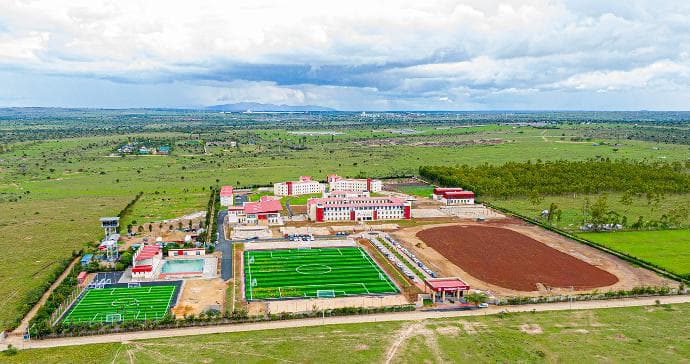
The site is located 800 metres off Namanga Road, on a murram road leading to Diaspora Village in Isinya, Kajiado County.
The natural beauty of the grassland savannah, with grass stretching as far as the eye can see, a few short trees, and very little immediate settlement, puts one at rest. The area is windy because of its vast openness, hot during daytime hours under direct sunlight, breezy through the day, and chilly in the evenings.
These conditions contribute to an excellent environment for the mental and physical wellbeing of the boys. The location also offers strong access for parents, with connections from JKIA and the SGR station, plus a scenic drive along Namanga Road with food joints, hotels, resorts, and destination stops.
Architectural inspirations
Each design choice connects the school to its environment while supporting safety, creativity, movement, and whole-boy formation.
The openness of the site inspired both built and unbuilt spaces. Space frees the mind, enhances creativity, creates buffer zones between activities, protects sensitive areas, brings in natural light and fresh air, and supports lively school spaces.
The campus uses orientation, shading, large openings, planted screens, solar power, solar hot water, wastewater reuse, and rainwater harvesting to reduce waste, regulate microclimate, and lower its lifetime carbon footprint.
Located in the heart of Maasai land, the master plan draws from the Maasai Emanyatta, using layered protection, clear movement routes, sightlines, and a central core surrounded by support activities.
Sustainability
Passive design strategies and campus systems work together to reduce energy demand and support daily comfort.
Buildings are oriented to reduce direct solar exposure and lower the need for air conditioning.
Solar shading, large openings, natural ventilation, and daylighting help regulate the campus microclimate.
Plant matter and live walls provide additional shading and cooling around key spaces.
A grid-tied solar power system reduces reliance on KPLC and lowers daytime generator output during outages.
Solar heat collectors, supported by solar-powered electric calorifiers, provide hot showers for students.
Wastewater is treated for toilet re-flushing, cleaning, and irrigation of lawns and beds.
Rainwater is harvested from roofs and surfaces and stored in a reservoir within the school.
Social setting
The Maasai traditional village, the Emanyatta, is a communal dwelling typically occupied by an extended family.
It is surrounded by a thorn fence, the Enkang, with access openings defining routes of movement to and from the village.
The huts, or Manyattas, form a protective ring around goat and sheep pens, which in turn surround the cattle shed, the Olosinko.
This layered security, clear sightlines, and protected centre inspired the school master plan: the most important activity sits at the centre, surrounded by support activities that buffer it from the outside world.
Movement, zoning and master planning
The school master plan follows the logical flow of student activities, with courtyards, buffers, and layers of care shaping the campus.
01
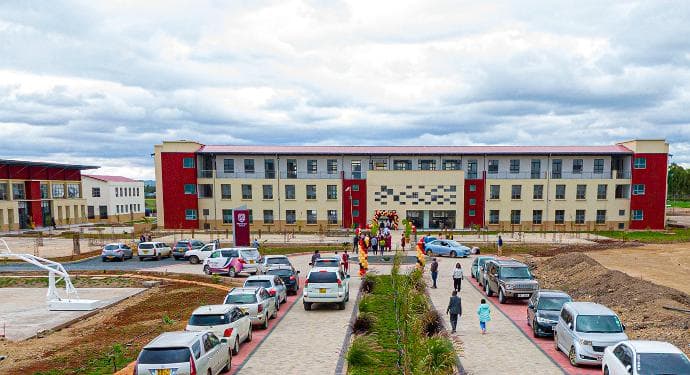
A centrally placed axis runs from the main gate through the site. A tree-lined boulevard leads to the administration block, with playing fields on both sides and shaded flash parking along the driveways.
02
The administration block is tied to the student resource centre, which hosts the school libraries. A 600-seat auditorium completes the first line of structures.
03
Behind the administration block, the tuition block is flanked by a dining hall for 1,200 people and a multipurpose hall for 2,000 people, separated by tree-lined courtyards that act as spill-out spaces.
04
The science block forms part of the tuition facilities and connects to the tuition block through a skywalk. Vocational workshops and a general-purpose warehouse for storage and laundry complete the third row of structures.
05
Beyond the science block, dormitories form a semi-circle around a large grass courtyard lined with trees. The dormitories include internal courtyards and a dorm parent's apartment on each floor.
06
Staff housing around the dormitory zone forms the final layer of structures, completing the community with a mix of one-, two-, and three-bedroom apartments for staff entrusted with boarding care.
Experience the campus
Visit Merishaw to see the arrival boulevard, courtyards, learning spaces, boarding community, sports grounds, and the wider campus environment.